

 When the coronavirus breakout was first identified in the Chinese city of Wuhan in late 2019, most people weren’t too worried.
Now that COVID-19 has spread around the globe, that’s changed, and we’re already seeing the effects in the world of motorcycling, especially involving events that attract enormous international crowds, feature riders from many diverse parts of the world and require airline or shipping to get people, bikes and freight from one country to another in quick time.
The season-opening MotoGP event scheduled for Qatar was cut back, racing going ahead without the premier MotoGP class, the MotoGP of Thailand, round two of the series due to be held in Buriram on March 22, has had to be postponed and the MotoGP of the Americas , in Austin, Texas, has now been rescheduled also. Round two of the World Superbike Championships in Qatar was also postponed and the Daytona 200 and Daytona TT races will be run without spectators in the stands.
Also in the United States, the AMA Indianapolis Supercross, set for March 21, has also now been cancelled, as has the AMA Seattle Supercross scheduled for March 28.

MXGP events like this one in France attract huge spectators numbers, thousands of screaming fans crowded together on the hillsides. This could be problematic if coronavirus takes more of a hold on the population.
News just out yesterday was that the opening round of the Australian MX Nationals at Horsham and the FIM Oceania Junior MX Tri-Nations Cup, originally set for April 4-5, have been postponed until later in the year. This is because it is not possible for international riders to travel to the event.
The MXGP of Patagonia – Argentina, originally scheduled for March 21-22, has also been postponed due to the coronavirus pandemic and it has now been tagged onto the end of the season and will be raced on November 21-22.
The MXGP of Spain and the MXGP of Portugal have also been postponed. Originally scheduled for April 18-19, the MXGP of Spain will now be postponed to October 10-11. Meanwhile, the MXGP of Portugal foreseen for April 25-26, will now be taking place on October 17-18.
How this will affect what is traditionally the last major motocross event of the season, the Motocross of Nations, still scheduled at this stage for Ernee, in France, on the weekend of September 26-27, is anybody’s guess.
Formula One car racing has been affected, major football competitions worldwide have been impacted, NBA basketball in the United States has been suspended and there has even been talk of the Summer Olympics (July 24-August 9) being moved to another country or postponed.
Motorcycling commentator Zac Kurylyk gives us his take on the impact that COVID-19 might have on motorcycling activities in the coming months …
He says it’s not just European racers who might feel the impact of COVID-19. There are some ways it might affect the average domestic rider, some obvious and some not-so-obvious.
Replacement parts and accessories
This will be hit-and-miss this summer, but some riders might encounter it.
Here’s the problem: The world economy is using Asia as a low-cost production centre, especially China. Although your motorcycle might be made by a Japanese, American or European manufacturer, there’s a good chance it has components that came from China. And China’s manufacturing sector is seriously set back right now, as some factories have shut down and others have reduced capacity.
Mind you, it very much depends where you are in the country, as areas farther from Wuhan are returning to work. As per this email we got from a US-based aftermarket gear maker, which outsources some production to China:
“Yes, we have experienced delays in production and shipping. But the good news for us is that we’re only a couple of weeks behind so far. Our new (product) just shipped via air freight from China, and we’ve been receiving confirmed updated shipping dates for other China-made products. We may see other impacts down the road, but for now China is returning to ‘business as usual’. Our manufacturing is done in south China, which is a long way from the middle of the country where the outbreak started, so the factories there are back to work.”

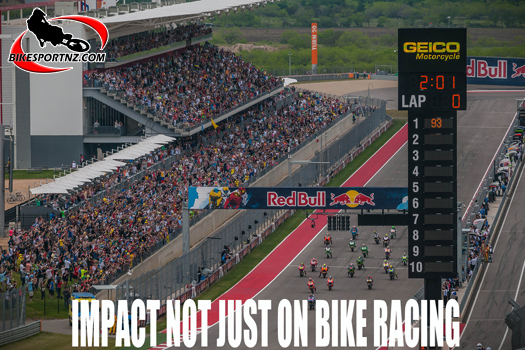
MotoGP typically attracts enormous international crowds and, in light of fears over coronavirus spreading out of control, many major sporting events like this are now being scaled back, postponed, cancelled or run behind closed doors or in front of empty stadiums or grandstands.
Still, even if some of the country is back to work now, the COVID-19 outbreak may make it hard to get some OEM parts during the season if they were originally sourced from China, but that’s very hard to predict. We’re more likely to experience a shortage of replacement wear parts, the stuff that most riders end up addressing every season.
There are still a lot of tyres made outside China, so finding rubber likely won’t be a major problem, unless all of Asia shuts down (unlikely). But other parts might be tricky, at least until new supply chains are established. Companies that sold made-in-China wheel bearings might have to find made-in-India wheel bearings now, and so on. Expect prices to change as a result, and probably not for the cheaper, sadly.
Reduced factory output
Want to buy that fancy new motorcycle you saw at the bike show? Oh, wait – it’s unavailable because the factory can’t get the components it needs to build the bike. Or the price has gone up, as the necessary parts have become more expensive for the factory to source. Or the factory itself has been shut down, as part of a government quarantine.
Now, to be clear, the only motorcycle factory closures we’ve heard of so far have been in China itself, and the bikes made there were for the local market. For now, the plants in Japan and Italy (both countries that have been heavily affected by COVID-19) are basically doing business as usual.
They might not be offering factory tours, they might have hand sanitizer everywhere, they might be asking office workers to telecommute, but, for now, they’re building bikes.
The Italian motorcycle press reports that the country’s factories are still producing bikes, despite some localised outbreaks.
One OEM’s press rep put it this way: “I can tell you that it has yet to affect us receiving our products in the time frame we would expect. Depending on where it goes in the upcoming months that could change, but that disruption would be solely based on speculation at this point.”
Unless the government shuts these factories down, chances are those factories will remain open for as long as possible. Production might be slowed a bit, and your bike might be a little more expensive than you expected, but you should be able to buy it.
There is one notable question mark, though, and that’s the western companies that are trying to push into China to sell their products there.
KTM has new Chinese production that’s supposed to come online later this year, and Harley-Davidson’s new 350 project is also supposed to start production soon. The 350 is certainly key to Harley-Davidson’s plans for the future, so the fallout from this will no doubt add to the company’s ongoing drama.
Protective equipment shortage
This is like the parts/accessories situation: There’s plenty of motorcycle gear made in China, but there’s lots made outside China, too. If you need a helmet or jacket this year, it’s hard to imagine you won’t find one, except the lowest-priced equipment might not be available until this blows over.
Restricted road-racing
Okay, this won’t affect your riding season, exactly, but for fans of MotoGP, World Superbikes and other border-hopping racing competitions, you can likely expect more of the jumbled mess we’ve already seen this week, with cancelled races. They’ve managed to sort out MotoGP at this point, but if it happens again, the people running the series are going to have to jam more races into less time, or they’ll just have to cancel some events.
In many countries, it’s difficult to see events facing any sort of cancellation. In domestic competitions, there are no borders being crossed, and not enough fans to really cause any major concerns.
Be aware that some travel insurance may no longer be covering coronavirus cancellations.
Travel restrictions
If you’re planning an overseas guided riding tour in 2020, don’t book without having solid travel insurance – although even that might possibly not protect you. And you should be careful about planning any self-guided trips. Already, there are stories about adventure riders facing difficulties exiting some countries in Africa. Most riders aren’t planning overseas travel on two wheels this year, but if you are, then expect complications from COVID-19.
With internal travel restrictions imposed in countries already, we’re more likely just to see riders staying at home, instead of travelling.
So where does this leave you and your bike?
We don’t even know that much about COVID-19 yet, relatively speaking. It may turn out to be no more scary than the flu, or it could turn into something worse, if infection rates grow. The rapidly-spreading nature of the coronavirus outbreak means we’re still in the early days of its impact in some more remote parts of the world (like New Zealand). Will it affect your riding season? Probably. Is it going to look like an apocalypse in a month? Probably not. But if it does, just remember that the best way to escape the apocalypse is on a motorcycle.
Photos courtesy MotoGP and MXGP
Find BikesportNZ.com on FACEBOOK here